


















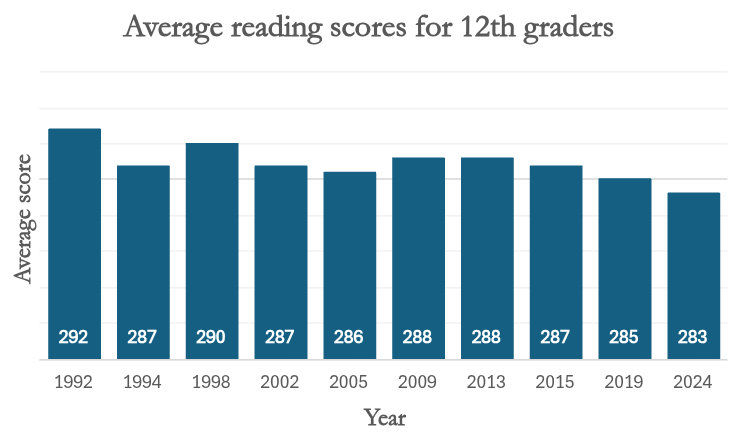
Literacy rates and reading scores in America have been dropping at a concerning rate. According to the Nation’s Report Card, scores are still below pre-pandemic levels half a decade later. While teachers are no strangers to students complaining about their assigned reading, it seems that recent technological and cultural developments have caused a spike in this behavior. Not only are students moaning and groaning about having to read a Shakespeare play, but they are displaying decreased levels of effort in and appreciation for literary education.
“I think some students feel stupid when they read Shakespeare, and so they don’t want to do it because they don’t want to feel dumb,” AP English Literature teacher Shannon Axtell said. “They don’t want to work that hard at pulling something apart. It’s time-consuming, and they don’t want to spend that much time on it.”
This growing sentiment that school requires more work than it is worth parallels the rapid growth of artificial intelligence (AI), a technology that lets students complete their work quickly, halving the work and critical thinking formerly needed to complete assignments.
“With the rise of AI and [the decrease in] student effort in general, I feel like, as I’ve gotten older, students are not getting dumber. They have just started caring less,” senior Ireland O’Dell, who is currently reading Macbeth in Axtell’s class, said. “I see much more value in leaning into teaching Shakespeare than leaning away from it. [It is an example of] what you can do in class to force students to actually engage with literature outside of their comfort zone.”
The fight to get students to not just learn, but to care about learning, is an uphill battle that teachers are having to wage. On top of that, educators must also figure out how to handle the emergence of AI technology in their classrooms.
“I do not feel like there is a love or desire to learn. It’s more like [a desire for] instant gratification, like the devaluation of knowledge, which just doesn’t matter anymore,” Axtell said. “It might be related to technology and the fact that you can look up anything now. That might be part of it, and AI can do the thinking for you.”
Students and their reading scores are not the only things suffering from the diminishing importance of education; teachers, whose careers are directly tied to how society perceives education, are experiencing a shift in the role they are expected to play.
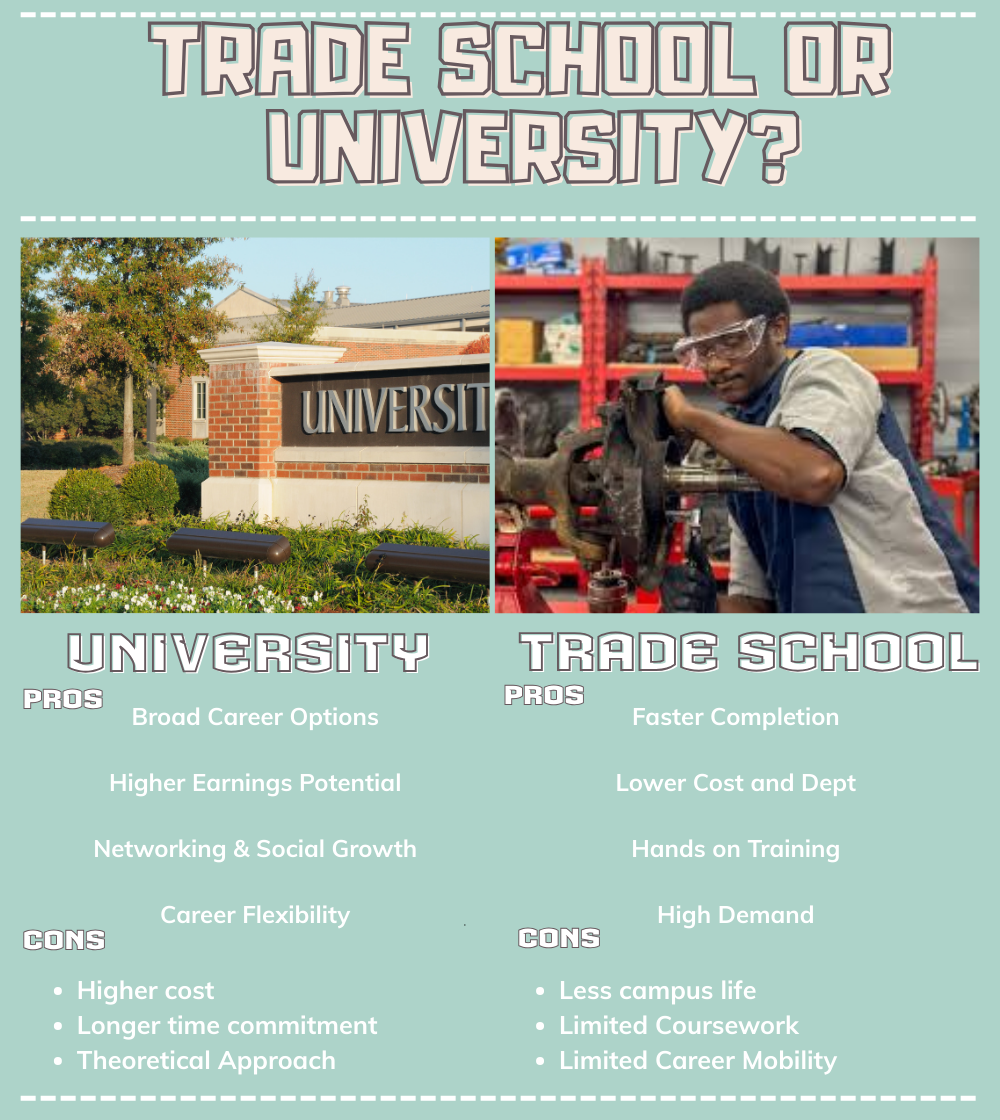
“My aunt, who was a teacher in the 1990s, was revered by her students…Now, it feels like the mindset is that we’re babysitters. [Teachers] are meant to babysit, not to educate,” Axtell said. “The mindset of the country has changed, where education is not really what’s important. It’s more about how much money you make, so a lot of people aren’t even trying to get an education. They’re just trying to get through college so they can make a lot of money.”
A possible reason for the decreasing importance of education is the increasing importance of profit in our society.
“I feel like students are just becoming lazier, and I feel like educators are having trouble not falling into giving them easier assignments. They’re straying away from more difficult materials for easier ones because that’s what feels appropriate. It’s like they’re not challenging the students anymore,” O’Dell said. “They’re not finding passions…Everyone is trying to find a shortcut or an easy way out or [to] get rich quick.”
It seems that children are not only in a hurry to become adults, but students are also in a hurry to become rich. School is just an obstacle between them and that ultimate goal.
“Everyone is aware of the problems with education and what teachers are struggling with and what students are struggling with, but there’s not a lot that is being done. I have a feeling that within 10 years, my job as an educator will look vastly different,” Axtell said. “I don’t know what it will look like, but it does feel like my job is less needed or less valued. I think education is definitely going to change, rapidly, and I don’t know if it’ll be education anymore.”
With the essence of education at risk, it is important that we as students, teachers and Americans ensure that intellectual standards are still upheld. In order to combat this trend, it is crucial that our institutions reinforce academic rigor and remind society of the value of education and holistic knowledge.
“Sometimes if [a teacher’s] kids struggle with Shakespeare, or maybe they don’t think it’s important, [they won’t teach it]. Because, truthfully again, is it necessary? No. You can teach [other works] and hit those same standards,” Axtell said. “Shakespeare influences a lot of what we read or consume, like even modern-day popular culture…I think the plays show a lot of emotional [struggles, and] I think the students, once they decipher and kind of piece through that, see a lot of emotions that they might relate to.”
Regardless of what future aspirations students have or careers they want to pursue, it is always important to have human compassion and empathy. Whether these students go on to major in STEM or law, reading comprehension and emotional maturity are fundamental characteristics to becoming a functioning member of society.
“It also creates empathy, and that’s something that I think the students sometimes are lacking,” Axtell said.


